





Is the Evil Eye Greek or Turkish? Country Origins Explained
Is the Evil Eye Greek or Turkish? Explore the evil eye origins and country explanations.
Evil eye jewellery is steeped in legend. It has captured imaginations from Istanbul to Santorini. This blue-eyed charm is a staple of fashion and gifting. But one question often arises: is the evil eye Greek or Turkish in origin? In this guide, we’ll explore the cultural origins of the symbol. We will see how it became a beloved motif in evil eye bracelets and necklaces. Discover why it remains a stylish talisman today. Let’s dive in, one question at a time!
What Exactly Is the Evil Eye?
The “evil eye” isn’t just jewellery. It’s a centuries-old belief found in many cultures. The evil eye is the idea that a malevolent glare can curse someone. To protect against this jinx, people created eye-shaped amulets. This concept dates back thousands of years. Archaeologists found eye amulets in ancient Mesopotamia. References also appear in Greek and Roman texts. The charm acts like a spiritual shield. It reflects back any ill will. This amulet evolved into the fashionable evil eye jewellery we know today. It ranges from dainty pendants to beaded bracelets. Wearers carry good luck and style wherever they go.

Where Did the Evil Eye Origins Begin?
Pinning down the exact origin of the evil eye is tricky. The tradition likely arose independently in multiple ancient civilizations. Some historians trace early amulets to ancient Mesopotamia around 5,000 years ago. Clay tablets there mention warding off a cursed gaze. The concept then spread across the Mediterranean and Middle East.
Ancient Greeks and Romans were wary of the “evil eye”. Authors like Hesiod and Plutarch wrote about it. Romans even used hand gestures to fend it off. Meanwhile, early Jewish, Islamic, and Hindu cultures developed evil eye folklore. The belief in an envious curse is a shared human superstition. It popped up in many places.
By the Ottoman era, the blue-glass amulet was popular in Turkey and Greece. The evil eye legend grew from a mosaic of cultures over millennia. It does not have a single birthplace.
Is the Evil Eye Originally Greek or Turkish?
Is it fair to call the evil eye either Greek or Turkish? Both cultures are huge contributors to its fame. Neither can claim exclusive ownership. Greek and Turkish traditions have each shaped the belief for centuries. In Greece, the “mati” (meaning “eye”) has been a household concept since antiquity. Any Greek yiayia will warn you about a jealous glare. Turkey became famed for its blue glass nazar beads. These were produced in bazaars and workshops during the Ottoman period. Many people now refer to the blue charm as the “Turkish eye.”
Greek and Turkish people lived side by side in the Eastern Mediterranean. Their evil eye customs intertwined over time. You will find similar blue-eye trinkets in Athens and Istanbul. Greeks and Turks often debate who started it. However, the evil eye symbol transcends borders. It is like asking who invented bread! Both cultures have used this symbol for ages. The evil eye isn’t exclusively Greek or Turkish – it’s both, and so much more. Each culture helped make it a global icon.
What Does the Evil Eye Mean in Greek Culture?
Belief in the evil eye runs deep in Greek culture. Nearly every Greek family has a story about “to mati”. An uncle might feel dizzy after an envious compliment. A friend then performs a secret prayer to remove the spell. The evil eye is called “kakó máti” or just “mati”.
Greeks fear an envious look can cause headaches or bad luck. It is common to mutter “ftou ftou” to ward off evil. Some pin a blue bead on a baby’s blanket for protection. A Greek host might jokingly say, “you killed me with the evil eye!” This happens if they suddenly feel unwell at a gathering.
Greeks turn to mati charms to guard against this curse. Greek eye jewellery often features a blue and white eye motif. You will see evil eye bracelet designs with tiny enamel eyes. Some wear a evil eye necklace pendant in gold or sterling silver.
Some Greek charms were filled with herbs or incense. This harkened back to Byzantine times. Modern ones are usually glass or painted ceramic. The mati symbol appears everywhere in Greece. You see it on keychains, wall hangings, and fishing boats.
For Greeks, the charm is a cultural emblem and a talisman. It says, “I’m protected and proud of my heritage.” Greek eye jewellery is a popular souvenir for UK travellers. It allows them to take home Greek good fortune.
What Does the Evil Eye Mean in Turkish Culture?
Turkish homes often feature the watchful gaze of blue eyes. In Turkey, this belief is known as “nazar”. The amulet is called “nazar boncuğu”. Turkish culture holds that jealous praise can unintentionally harm someone. This is almost identical to the Greek concept. To counteract this, Turks use clever customs. One tradition is saying “Maşallah” when praising someone. This credits God to nullify any evil eye. The most visible solution is the many blue eye amulets.
Turkish eye jewellery is typically made of handmade glass. It features concentric circles of dark blue, white, and light blue. A black dot at the center resembles an eye. These evil eye beads have been crafted in Anatolia for generations. You can visit workshops where artisans blow the glass.
Turks hang large nazar discs in homes and offices. They also use them as keychains or jewellery. An evil eye bracelet with nazar beads protects the wearer. It “stares back” at any ill-wisher to protect from misfortune.
Gifting a nazar charm for a new house or business is common. This safeguards a fresh start. Turkish evil eye jewellery carries a rustic, authentic vibe. UK visitors often fall in love with this style. Turkish eye jewellery is now synonymous with the symbol worldwide.
Many market stalls in Turkey and Greece sell blue amulets. The Turkish eye jewellery tradition popularised the cobalt-blue glass charm. This design is now used in Greek markets and worldwide. Each bead is crafted to resemble a watchful eye. These charms remind us of a shared cultural heritage.
Why Do People Wear Evil Eye Jewellery Today?
The evil eye symbol has exploded as a fashion trend. In the UK and Western world, it is now in vogue. It blends style with spiritual meaning. People are drawn to the vibe of protection from bad energy. It is comforting to wear a symbol that looks out for you. These designs are eye-catching and versatile.
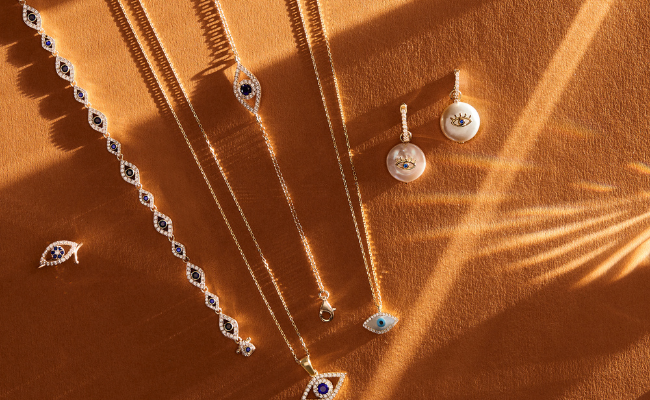
Celebrities and influencers often wear evil eye pieces. This gives the talisman a glamorous twist. Hollywood stars wear delicate gold evil eye necklace pendants. Pop stars stack bold beaded evil eye bracelets. High-end jewellers now create luxury evil eye jewellery with diamonds and sapphires.
This jewellery marries timeless meaning with modern style. You get a boho-spiritual vibe and a trendy accessory. In the UK, these designs are in boutiques and high street stores.
Pair a gold pendant with a black dress for elegance. Use a colourful bead bracelet for a casual outfit. Some believe in its power; others just love the look. Wearing it carries positivity and cultural history. You can look effortlessly stylish while doing so.
Modern evil eye necklace designs have turned an ancient amulet into a fashion statement. These pieces are set in precious metal and often accented with crystals. They demonstrate the luxurious side of evil eye jewellery. They are subtle for everyday wear yet spark conversations. Style-conscious individuals embrace this trend for glamour and good vibes.
Are Evil Eye Jewellery Gifts a Good Idea?
Evil eye jewellery gifts are a fantastic choice for meaningful presents. They carry a heartfelt message of protection and well-wishes. Gifting a bracelet says, “I care about your safety and style!”
These charms are common gifts for significant life events. For a new baby, a pin or bracelet wards off negative stares. For a new home, a hanging ornament is a customary token in Turkey.
This practice translates perfectly into modern gift-giving. An evil eye piece is appropriate for birthdays or graduations. It is essentially a good luck charm in a beautiful design.
Evil eye jewellery is generally unisex and suits all ages. Subtle designs offer minimalist elegance. For example, a tiny sapphire pendant on a delicate chain. Bold designs suit a boho-chic friend with dangling beads.
The symbol is recognisable and steeped in story. It often acts as a built-in conversation starter. The recipient can tell the tale behind the accessory. In the UK, such a gift feels unique and exotic.
Giving an evil eye gift shares a piece of culture. It conveys well-wishes to a loved one. It adds a touch of mystical charm to their collection.
Greek vs Turkish Evil Eye Jewellery – Is There a Difference?
Does Greek eye jewellery differ from Turkish eye jewellery? In meaning and usage, they are virtually the same. Both are worn for protection and cultural roots. However, there are some subtle differences in style.
Turkish evil eye jewellery sticks to the classic design. It uses the traditional nazar bead of deep blue. You find these in Istanbul’s Grand Bazaar. The focus is often on that vivid blue color.
Turks believed blue eyes could cast the evil eye. Thus, a blue eye amulet fights back! Turkish jewellers often use rope or cord for a rustic look. They sometimes combine the eye with other luck symbols like horseshoes.
Greek evil eye jewellery often uses the same blue motif. However, it can take a more modern artistic approach. Greek designers might stylise the symbol more. You will find mati charms in turquoise, light blue, or pink.
A trendy Greek piece might use a rose-gold chain. It could feature an enamel eye in white and sky-blue. Some add a tiny cross or other Greek lucky symbols.
Greek versions can be more delicate or fashion-forward. They blend the symbol with contemporary trends. However, the overlap is huge. Tourists in Athens find products identical to Turkish ones.
For a UK shopper, the distinction isn’t critical. You are getting a piece of the same history. Turkish jewellery is the original blueprint, and Greek is the local remix. Both are beautiful and meaningful. The charm bridges cultures as a stylish conversation piece.
So, Is the Evil Eye Greek or Turkish? (The Verdict)
The evil eye’s origin isn’t a simple this-or-that answer. Both cultures consider it an integral part of their heritage. It is a shared treasure of the Mediterranean world.
This symbol of protection hopped between cultures over centuries. It picked up new styles and stories. Greeks and Turks have much in common here. The phrase “evil eye” in local languages illustrates this crossover.
Greeks may call it a “Greek eye”. Turks call it a “Turkish eye”. Folklore suggests blue eyes are most likely to cast the spell. Therefore, a blue amulet is the best defense!
Asking if it is Greek or Turkish is like asking where the sun rises. It is seen in both skies. The evil eye belongs to everyone who admires its beauty. Good ideas travel well across the globe.
Next time you wear your evil eye bracelet, remember its history. It is shared by many cultures. The origin doesn't matter. What matters is the positive energy and style it brings.
And in a world full of fleeting trends, the evil eye’s lasting allure is something we can all appreciate. After all, protection and glamour make one divine combination, don’t you think?


